A “Below-Normal” Hurricane Season Doesn’t Mean Lower Risk: Why Government Readiness Still Matters in 2026
The 2026 Atlantic hurricane season is entering its most consequential period.
This year, however, the headline is different.
NOAA’s seasonal outlook calls for a 55% chance of a below-normal Atlantic hurricane season, with a 35% chance of near-normal activity and just a 10% chance of an above-normal season. The agency projects 8–14 named storms, including 3–6 hurricanes and 1–3 major hurricanes.
For government agencies and contractors responsible for emergency response, infrastructure, environmental services, and community recovery, it would be easy to interpret those numbers as a reason to reduce readiness.
That would be a mistake.
A lower seasonal storm count does not necessarily translate into lower operational risk. It only takes one significant landfall, or one major flood, wildfire, infrastructure failure, or other emergency, to create an immediate requirement for qualified personnel, equipment, environmental resources, engineering expertise, and field management.
For government programs, readiness cannot be determined by the seasonal forecast alone.
Below-Normal Does Not Mean No Impact
NOAA’s 2026 outlook highlights an important distinction between seasonal forecasting and operational preparedness.
Seasonal outlooks estimate overall activity across the Atlantic basin. They do not predict exactly where storms will form, where they will make landfall, or which communities and infrastructure systems could be affected.
A season with relatively few storms can still produce a high-impact event.
That matters as we enter August, September, and October, the period when most Atlantic hurricane activity historically occurs.
Government agencies and their industry partners therefore face a familiar preparedness question:
If a major event occurs tomorrow, how quickly can we move from planning to execution?
The answer depends on much more than an emergency response plan.
It depends on having access to qualified people, equipment, technical expertise, logistics, management systems, and contracting capacity before those resources are urgently needed.
Emergency Management Is Becoming a Year-Round Capability
The broader challenge facing government programs in 2026 extends well beyond hurricanes.
Flooding, wildfires, severe storms, infrastructure failures, environmental incidents, and other emergencies increasingly require agencies and contractors to maintain scalable response capabilities throughout the year.
The traditional model of preparing for a single “disaster season” is becoming less effective.
Modern emergency-management programs need the ability to activate different combinations of resources depending on the event:
- Construction and heavy equipment personnel
- Engineers and technical specialists
- Environmental professionals
- Safety and quality personnel
- Field supervisors and project managers
- Equipment operators and labor teams
- Logistics and administrative support
- Inspection and assessment resources
- Contract administration and compliance personnel
The requirement is not necessarily to keep all of those resources permanently deployed.
It is to know how they will be accessed and mobilized when conditions change.
The First 48 Hours Can Define the Response
Following a major event, response requirements can accelerate quickly.
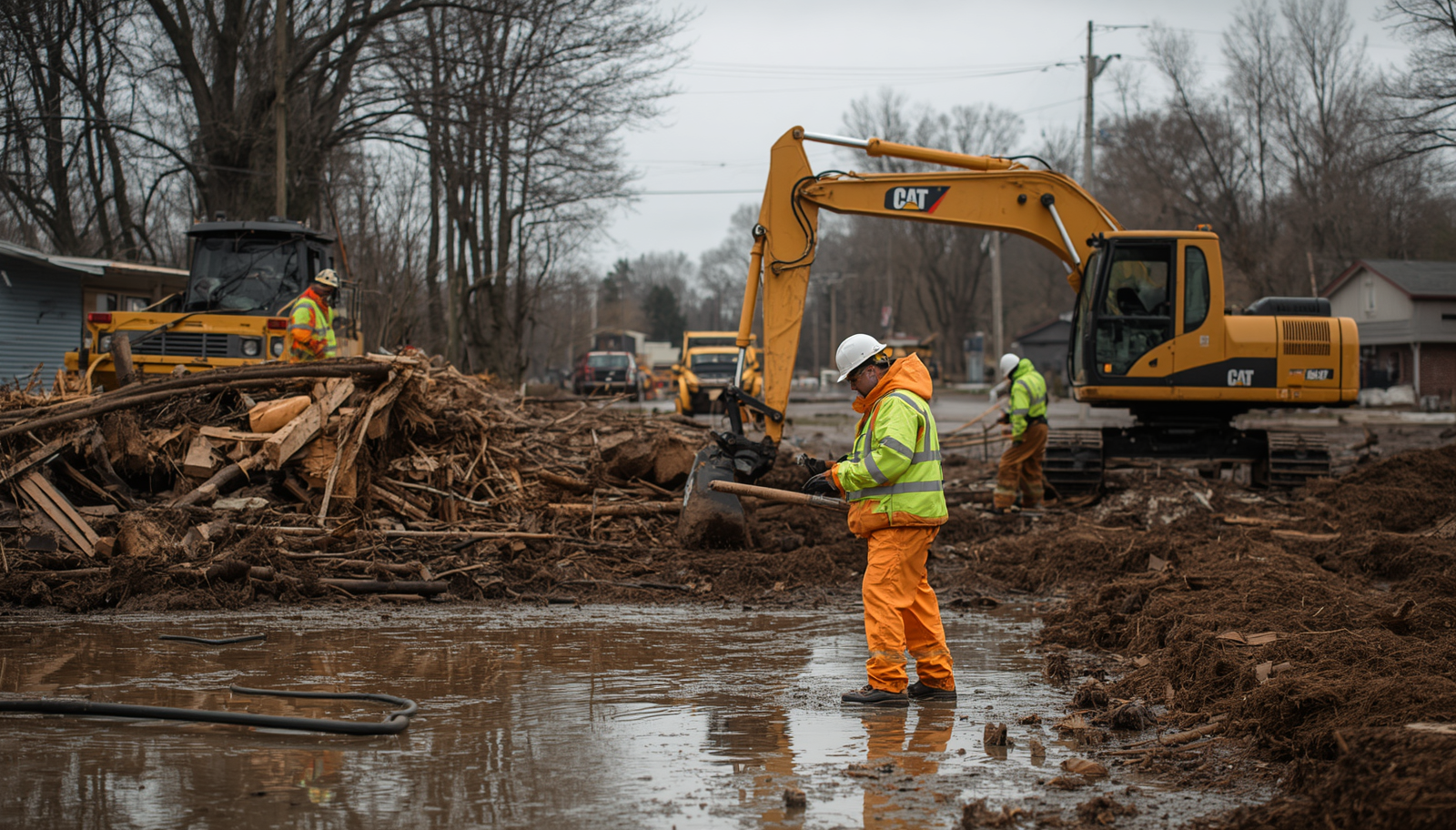
Roadways may need to be cleared. Public facilities may require inspection. Debris must be characterized and removed. Utilities may need assessment or temporary support. Environmental hazards must be identified. Field personnel must be mobilized.
At the same time, government agencies and prime contractors must maintain safety, documentation, quality control, environmental compliance, and contractual accountability.
That combination creates one of the most difficult challenges in emergency management:
Moving quickly without losing control of execution.
Rapid mobilization is valuable only when the resources being deployed are qualified, properly managed, and aligned with the mission.
That makes advance planning critical.
Organizations that wait until an emergency occurs to identify personnel, subcontractors, equipment, and technical partners can find themselves competing for the same limited resources at precisely the moment demand is highest.
Infrastructure Assessment Comes Before Infrastructure Recovery
Once immediate life-safety priorities are addressed, government recovery programs quickly shift toward infrastructure.
Roads, bridges, drainage systems, utilities, public buildings, water systems, military installations, and other assets may require rapid inspection and assessment.
Engineering resources can support that transition through capabilities including:
- Site and damage assessments
- General and heavy civil engineering
- Water-resource engineering
- Hydrology and hydraulics
- Design and drafting
- GIS and mapping
- Project controls and scheduling
- Construction management
- MEP systems support
Accurate field information allows agencies to prioritize limited resources, establish scopes of work, develop recovery schedules, and determine which assets require immediate stabilization versus longer-term reconstruction.
The faster reliable information reaches decision-makers, the faster recovery can move forward.
Environmental Risk Does Not End When the Storm Passes
Major disasters can also create environmental impacts that continue long after the immediate event.
Floodwater can distribute contaminants.
Damaged industrial and commercial facilities can release hazardous materials.
Water and wastewater infrastructure may be compromised.
Large debris streams can contain chemicals, fuels, asbestos-containing materials, electronic waste, and other materials requiring specialized handling.
Environmental support therefore becomes an important component of both response and recovery.
Depending on the event, government programs may require:
- Environmental assessments
- Testing and monitoring
- Hazardous-material management
- Environmental health and safety support
- Water and wastewater services
- Laboratory and field support
- Remediation
- GIS and mapping
- Planning and permitting
- Regulatory compliance documentation
Emergency conditions accelerate schedules. They do not eliminate environmental responsibilities.
Surge Capacity Is Also a Federal Contracting Issue
Government agencies are not the only organizations that must prepare.
Prime contractors supporting FEMA, USACE, DoD, state agencies, municipalities, and other public-sector customers can experience the same capacity constraints.
A contractor may already hold the appropriate contract vehicle and possess the technical qualifications required for the work.
The challenge comes when multiple projects activate simultaneously.
A contractor that normally requires 20 field personnel may suddenly need 75.
One project manager may become four.
A single environmental team may need to operate across multiple locations.
Safety, quality, project controls, logistics, administration, and documentation requirements expand alongside the field workforce.
That creates an execution gap between winning the work and having the resources required to perform it.
Experienced teaming partners can help close that gap.
Federal Infrastructure Programs Face the Same Capacity Challenge
The need for scalable resources is not limited to emergency response.
Federal infrastructure and military construction programs continue to create requirements across construction, engineering, environmental services, project controls, safety, quality, and field operations.
The U.S. Army Corps of Engineers, for example, continues to advertise FY2026 construction opportunities involving dredging, structural repair, water infrastructure, civil works, and other projects across its districts.
At the same time, federal contractors must navigate increasingly complex requirements surrounding safety, prevailing wages, quality management, environmental compliance, documentation, and schedule performance.
For prime contractors, the question increasingly becomes:
Can our delivery capacity scale as quickly as our contract pipeline?
That is where flexible project-based and surge resources become strategically important.
Instead of carrying every potential resource internally, contractors can build qualified networks that allow specialized personnel and teams to be deployed as requirements materialize.
Preparedness Is a Capacity Strategy
Emergency preparedness is often viewed primarily through the lens of plans, procedures, and exercises.
Those remain essential.
But preparedness is also a capacity strategy.
Before an event occurs, agencies and contractors should understand:
What resources are likely to be required?
Identify critical construction, engineering, environmental, safety, quality, logistics, and management roles.
Where are the potential gaps?
Determine which capabilities can be provided internally and which will require outside support.
How quickly can resources mobilize?
A technically qualified partner that requires weeks to deploy may not solve a requirement measured in hours or days.
Can resources scale?
A partner capable of providing two specialists may not necessarily be able to provide 20 when multiple locations activate.
Are compliance systems already established?
Safety, quality, environmental, payroll, documentation, and contractual requirements should not be developed after mobilization begins.
The objective is straightforward:
Reduce the number of problems that must be solved after the emergency has already started.
How Certis Government Services Supports Mission Readiness
Certis Government Services supports government agencies and contractors nationwide across construction, engineering, environmental services, and emergency management and disaster recovery.
Our emergency-management capabilities include:
- Rapid response and mobilization
- Cleanup and debris removal
- Field teams and equipment operators
- Safety and oversight
- Quality management
- Environmental testing and monitoring
- Project management and supervision
- Logistics and field support
- Contract administration and compliance
Our broader construction, engineering, and environmental capabilities allow CGS to support programs beyond the immediate response phase and into infrastructure assessment, stabilization, reconstruction, remediation, and long-term recovery.
CGS also supports federal contractors throughout the acquisition and execution lifecycle—from pre-award planning and resource identification through post-award mobilization and project delivery.
That model is designed for one of the realities of government contracting:
Requirements can change faster than permanent organizations can scale.
Readiness Should Not Depend on the Forecast
The 2026 Atlantic hurricane outlook may call for below-normal activity.
Government agencies and contractors should welcome that possibility.
But lower predicted activity is not the same thing as lower preparedness requirements.
A single major hurricane can create billions of dollars in damage. A wildfire can require immediate nationwide resource mobilization. A flood can disrupt transportation, utilities, public facilities, and environmental systems simultaneously.
And those events do not wait for organizations to finish recruiting, procurement, onboarding, or subcontractor negotiations.
The organizations best positioned to respond will be those that establish their capacity before the requirement becomes urgent.
The forecast determines what may happen. Readiness determines what happens next.
About Certis Government Services
Certis Government Services (CGS) is a trusted, results-driven partner supporting government programs nationwide. CGS delivers mission-ready solutions across construction, engineering, environmental, energy, and emergency-management sectors, backed by proven experience and technical expertise.
As a certified small business with CONUS and OCONUS reach, CGS supports the government acquisition lifecycle with pre-award, post-award, project-based, and rapid-response resources designed to help government agencies and industry partners execute with confidence.
Building surge capacity for an upcoming federal project or emergency-management requirement? Connect with Certis Government Services to discuss mission-ready support.